
New Year, New Neural Pathways: Building Healthy and Consistent Habits
By: Kyla Basbaum
With a New Year right around the corner, many of us feel inspired to start fresh and become our best selves. However, this motivation is often coupled with an undercurrent of pressure—pressure to do better, be better, and stay rigidly consistent in our resolutions. These goals can quickly shift from hopeful intention to stress, as we strive to uphold our own high standards. We expect consistent motivation, rapid progress and flawless discipline, but we often overlook the need for sustainable plans and misunderstand what truly supports long-term change. It’s no surprise that many of us start to feel as though we’re falling behind before the year has even begun.
This year, try to reframe how you are going to achieve your New Year's resolutions. Because what if lasting change lies not in motivation, but in how our brain forms habits?
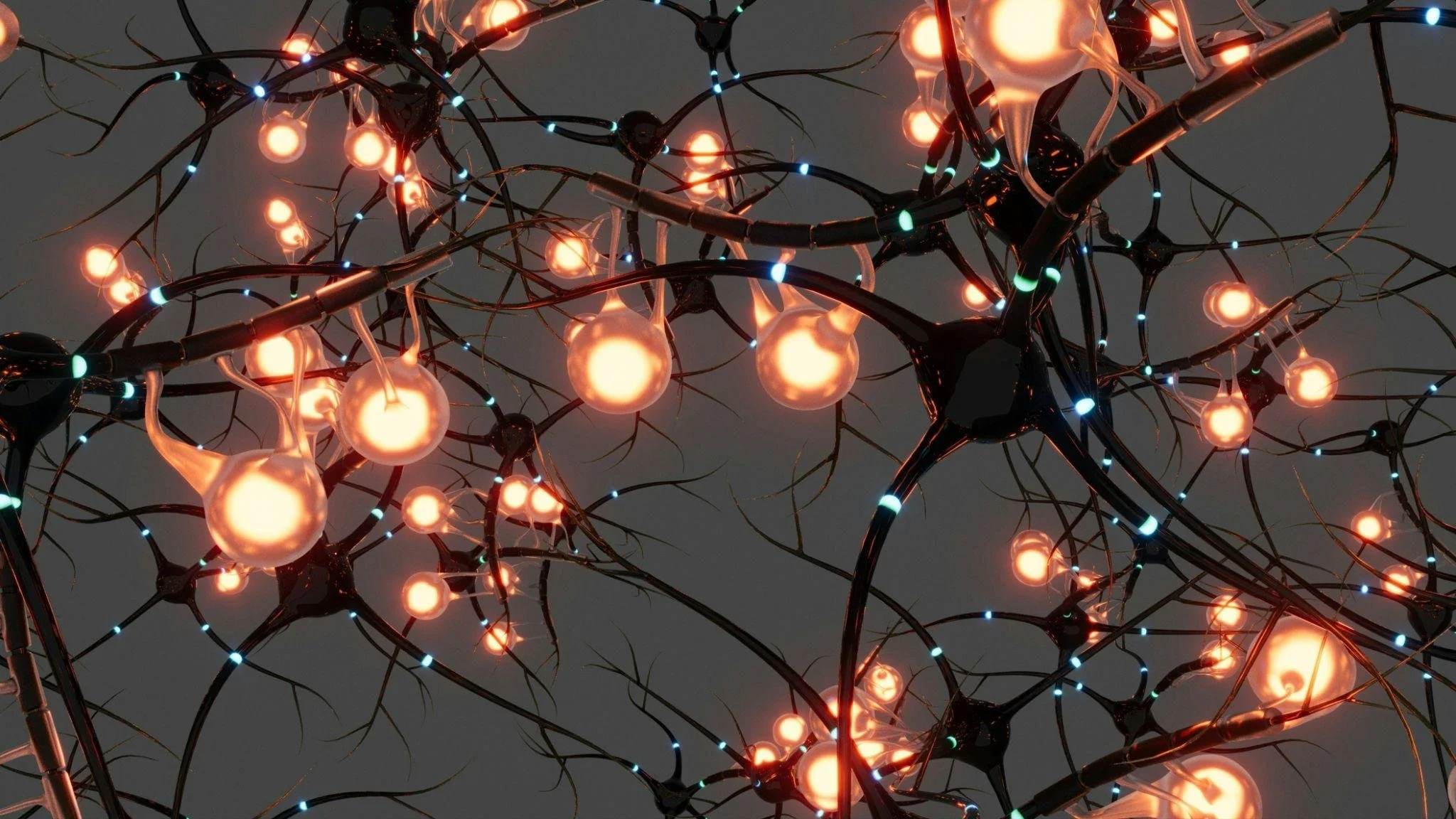
Let’s start with some terminology. Neuroplasticity is the brain’s natural ability to adapt its physical structure and function by forming and strengthening new neural connections. This enables us to learn new skills, form habits, and recover from stress or injury. The process is often described as Hebbian theory (1949), and is summarized by the phrase, “neurons that fire together, wire together” (1). Repeated and consistent activation of neural pathways strengthens them, making learned behaviours easier and more efficient over time.
Habits are automatic behaviours triggered by cues, and are performed with little conscious thought, as a result of learned association (2). To turn deliberate actions into effortless routines, two key brain regions are activated: the prefrontal cortex (PFC) and the basal ganglia. Together, these two regions are heavily involved in decision making, goal setting, pattern recognition, and reward-based learning!
Our dopaminergic reward system also plays an essential role. Dopamine is a “feel-good” chemical tied to reward and motivation, and is released in our brain when performing certain behaviours (4). Over time, we begin to anticipate this burst of dopamine, making us more likely to repeat these actions. In his 2012 book, “The Power of Habit", author Charles Duhigg identifies a psychological cycle known as the Habit-Loop Theory, a cue-routine-reward feedback loop that shapes how behaviours become automatic (5). This pattern is made up of three parts:
➢ Cue: An internal or external trigger activating a behaviour, (e.g. time of day, mood, environment)
➢ Routine: Response to the trigger or the behaviour itself (physical, mental, or emotional)
➢ Reward: The outcome, or reinforcement of a behaviour (dopamine!)
While motivation can inspire us to begin working toward a goal, it’s often a limited resource. Motivation naturally fluctuates with mood, energy, and environment. Research suggests that it’s not motivation that drives habit formation, but rather ef ort that leads to intrinsic motivation (6). Small, consistent actions help the brain associate behaviours with progress and reward (8). Over time, this neural rewiring encourages a cycle of effort (consistency and persistence) followed by reward (motivation). This self-reinforcing pattern is what shapes our habits, building us a foundation for lasting change.
So how can we integrate this into our everyday lives?
1. Start small and build momentum (7, 8). Begin with one specific, manageable task, such as drinking a glass of water in the morning or taking a short daily walk.
2. Prioritize consistency over intensity. If your goal is to run a marathon, begin with brief, everyday runs. Focus on regularity and accountability; consistency reshapes neural pathways for success (7).
3. Make it meaningful. Choose habits that align with your personal values or bring genuine satisfaction. Habits connected to purpose are easier to sustain.
4. Acknowledge progress. Rewarding small wins strengthens the habit-loop.
5. Be kind to yourself. Slip-ups are normal. Flexibility and self-compassion will support long-term success far better than perfectionism.
References:
1. Hebb, D.O. (2002). The Organization of Behavior: A Neuropsychological Theory (1st ed.). Psychology Press. https://doi.org/10.4324/9781410612403
2. Gardner B. (2015). A review and analysis of the use of 'habit' in understanding, predicting and influencing health-related behaviour. Health psychology review, 9(3), 277–295. https://doi.org/10.1080/17437199.2013.876238
3. Young CB, Reddy V, Sonne J. Neuroanatomy, Basal Ganglia. [Updated 2023 Jul 24]. In: StatPearls [Internet]. Treasure Island (FL): StatPearls Publishing; 2025 Jan-. Available from: https://www.ncbi.nlm.nih.gov/books/NBK537141/
4. Wickens, J. R., Horvitz, J. C., Costa, R. M., & Killcross, S. (2007). Dopaminergic mechanisms in actions and habits. The Journal of neuroscience : the official journal of the Society for Neuroscience, 27(31), 8181–8183. https://doi.org/10.1523/JNEUROSCI.1671-07.2007
5. Duuhigg, C. (2012). The power of habit: Why we do what we do in life and business. Random House.
6. Inzlicht, M., Shenhav, A., & Olivola, C. Y. (2018). The Effort Paradox: Effort Is Both Costly and Valued. Trends in cognitive sciences, 22(4), 337–349. https://doi.org/10.1016/j.tics.2018.01.007
7. Lally, P., van Jaarsveld, C.H.M., Potts, H.W.W. and Wardle, J. (2010), How are habits formed: Modelling habit formation in the real world. Eur. J. Soc. Psychol., 40: 998-1009. https://doi.org/10.1002/ejsp.674
8. Akash, Maksudul Shadat & Chowdhury, Shahanaz. (2025). Small changes, big impact: A mini review of habit formation and behavioral change principles. World Journal of Advanced Research and Reviews. 26. 3098-3106. 10.30574/wjarr.2025.26.1.1333.
Photo Credits: Unsplash.com
